Skylark Group Procurement Policy
To realize the management philosophy of "Creating Richness with Value to Society", we believe it is important to meet the requirements of laws and regulations, and continuously provide safe and secure products to "provide valuable richness” through “food service” to our customers, which is an important responsibility of Skylark Group.
In order to earn the trust of our stakeholders, we ask our suppliers to understand and practice the following items regarding respect for human rights and global environmental conservation. We aim for coexistence and co-prosperity with our suppliers in our corporate activities and social and environmental responsibilities.
- Suppliers shall only provide safe products that meet the Food Sanitation Law of Japan and other related laws and regulations, and quality standards of the Company. Also, suppliers shall understand and cooperate with the inspection and audit of their manufacturing process of their products that the Company requests.
- In addition to providing only those products that pass bacterial tests conducted by our company, suppliers shall cooperate in providing information on food safety and quality required by the Company, including reports from external organizations regarding residual pesticides.
- Suppliers shall respect the human rights of their employees and will not treat them inhumanely.
- Suppliers shall prevent forced labor and child labor in their employees, eliminate excessive working hours in violation of laws and regulations, and secure minimum wage.
- Suppliers shall not engage in employment discrimination.
- Suppliers shall respect the freedom of association of employees and the right to collective bargaining in order to facilitate smooth discussions between labor and management.
- Suppliers shall strive to provide employees with a safe, hygienic and healthy working environment.
- Suppliers shall comply with relevant domestic and foreign laws and regulations. Suppliers shall also ensure compliance to fair transactions and anti-corruption.
- Suppliers shall emphasize the sustainability of natural resources and strive to conserve resources, and minimize the use of non-renewable resources. Natural resources obtained through illegal trade, extraction, or fishing shall not be used.
- Suppliers shall endeavor to understand and cooperate with our policy on biodiversity, animal welfare, energy saving, renewable energy, water conservation, food loss reduction, waste reduction, climate change, CO2 / GHG emission reduction, etc. Also, suppliers shall endeavor to understand and cooperate with the Company regarding communication, information provision, training, etc. regarding various issues.
- Suppliers shall provide and disclose information regarding all items above in a timely and appropriate manner.
January 13, 2021
Approved by Group Sustainability Committee
Response to Material Breaches
In the event of a material breach relating to this policy, we shall, upon verifying the facts, request that the supplier improve the situation. We ask all suppliers and secondary suppliers to be aware of and thoroughly adhere to the CSR Procurement Guidelines. If necessary, we or our designated experts will visit the site and conduct investigation. In addition, if no improvement has been made after a specified period, we will take measures which may include a reconsideration of the contract with the supplier or business partner.
Governance
We have established the "Group Sustainability Committee" to promote sustainability management across the entire Group. The Group Sustainability Committee deliberates on and oversees policies, targets, initiatives, and progress related to "Responsible Procurement," a key material issue (materiality), and regularly reports to the Board of Directors.
For KPIs related to "Responsible Procurement," targets are set for each responsible Executive Officer and Director (department head level). Achievement status is directly linked to individual performance evaluations (affecting bonus fluctuations and evaluation grade determinations), ensuring governance with strong execution capabilities.

Strategy
With growing recognition of the importance of providing sustainable food and fulfilling social responsibility, raw material procurement within global supply chains has the potential to significantly impact the environment and human rights. To ensure a stable supply of diverse ingredients, we work closely with domestic and international suppliers. We believe that reducing environmental impact during the procurement process and protecting workers' human rights are essential for sustainable corporate growth.
Regarding the materiality issue of "Responsible Procurement," we have identified the following risks and opportunities:
Risk Management
Medium- to long-term risks and opportunities related to "Responsible Procurement" are overseen by the Group Sustainability Committee, while overall risk is overseen by the Group Risk and Compliance Committee. Both committees collaborate to designate responsible departments for each risk to be addressed and implement appropriate preventive and response measures.
Details of deliberations in both committees are shared with outside directors in an effort to ensure transparency in the risk management framework. Additionally, outside directors serve as advisors to both committees, creating a structure that receives input and advice from an external perspective. The Board of Directors receives regular reports from the Group Sustainability Committee and oversees the status of risks and the management system.
Indicators and Targets
Promoting Responsible Procurement
Skylark Group has established purchasing management regulations to fulfill its social responsibilities through business operations. Beyond legal compliance, we are committed to promoting the procurement of safe, high-quality ingredients and addressing social challenges. Furthermore, the Group Sustainability Committee meets as needed to continuously formulate policies, targets, and initiatives for responsible procurement.
In selecting suppliers, we prioritize those demonstrating significant progress in Environmental, Social, and Governance (ESG) initiatives. Beyond financial reliability and quality stability, we incorporate comprehensive ESG criteria into our evaluation process. This includes employee management based on the International Labour Organization (ILO) Core Labour Standards (such as ensuring occupational health and safety) and respect for human rights (including the elimination of child labor, forced labor, discrimination, and harassment, as well as the protection of freedom of association and collective bargaining, and the prevention of excessive working hours).
Our criteria also cover environmental stewardship—including energy use, climate change, pollution prevention, waste and water management, biodiversity, other environmental issues, food loss reduction, and resource utilization—alongside ethical compliance (anti-corruption, management of conflicts of interest, and prevention of anti-competitive behavior) and the monitoring of any other antisocial conduct. We uphold compliance with these international standards as our "common guidelines" for responsible procurement, shared with all our business partners.
Moreover, we encourage our suppliers to implement and obtain certification for environmental management systems such as ISO 14001. In line with this, we require compliance with our expectations, which include reducing raw material consumption, tracking greenhouse gas emissions, reducing the use of hazardous substances, and ensuring the proper treatment of hazardous waste and harmful atmospheric emissions.
We also ask suppliers for their understanding and cooperation in providing information relating to our environmental policies, communication with our company and training activities, to engage in joint corporate activities and aim for coexistence and co-prosperity of society and the environment together.
Currently, we have suppliers in 40 countries around the world. We do not judge based on the local laws, customs, and conditions of each region, but rather on whether there are any significant discrepancies when benchmarked against international standards. We strive for responsible procurement by enforcing a strict policy of not initiating transactions if any problems are found.
1. Supplier Selection
When selecting new suppliers, we conduct the following due diligence on all suppliers prior to the start of transactions in accordance with our "Detailed Rules for Sustainable Procurement Management" for the purpose of risk assessment of environmental and social issues.
In our supplier selection process, we have introduced a methodology to consider and evaluate the following sustainability risks:
- Country-specific risks: We consider the risk of negative ESG impacts related to the political, economic, environmental, and regulatory conditions in the countries and regions where the supplier operates.
- Sector-specific risks: We consider the risk of negative ESG impacts related to labor conditions, emissions, and pollution within the sector to which the supplier belongs.
- Product-specific risks: We consider the risk of negative ESG impacts related to the supply chain structure, labor conditions, energy consumption, emissions, and pollution of the procured products.
In the selection process for new suppliers and the decision-making process for contract renewals, Skylark Group incorporates ESG evaluation results—derived from the evaluation process described below—into its scoring criteria as key indicators alongside quality, price, and delivery. By assigning a specific weight to ESG factors within the evaluation scoring, Group operates a framework that prioritizes the selection of suppliers with superior ESG performance.
Due Diligence Process
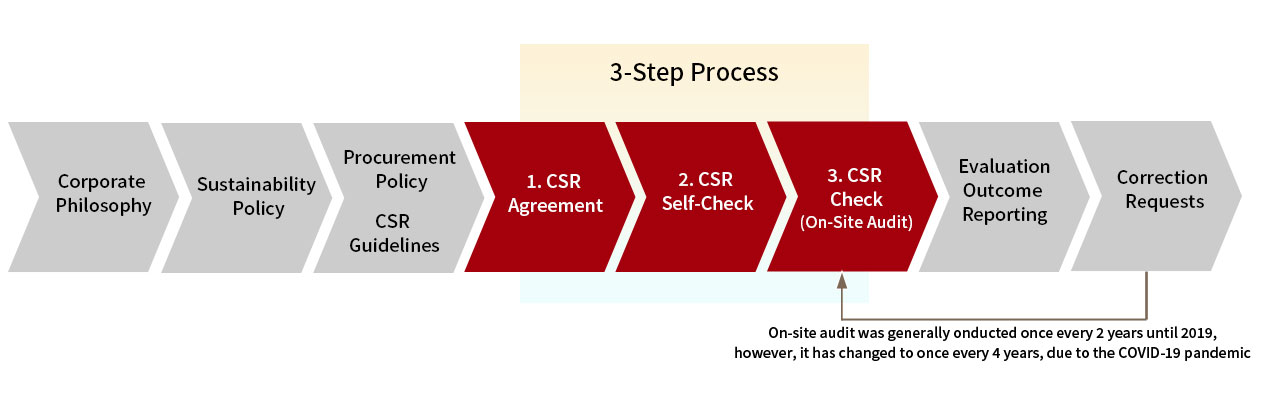
- CSR Agreement: All suppliers are required to agree to the Group's procurement guidelines prior to the commencement of business. This process ensures a shared understanding and commitment to our standards from the beginning of the partnership.
- CSR Self-check: Suppliers are requested to provide specific information regarding their ESG policies and the status of their activities. These responses are scrutinized against established evaluation criteria, and scoring is performed to verify alignment with the Group's internal standards.
- CSR Check: Our buyers visit supplier factories to conduct on-site evaluations and drive improvement activities in collaboration with partners. Using a CSR checklist, we mutually verify the implementation status of requirements and share best practices to ensure continuous growth.
*The scope of these monitoring and audit activities is not limited to direct (Tier 1) suppliers but also extends to certain upstream Tier 2 suppliers, as we strive to mitigate risks across the entire supply chain.
*Supplier evaluations are conducted with reference to the methodology of the Global Compact Network Japan's supply chain subcommittee.
Scope of coverage
2. Supplier Monitoring and Audit
- Regardless of location or transaction volume, we regularly monitor and audit all suppliers, with a target frequency of once every two years. In this audit process, we utilize tools provided by Global Compact Network Japan (GCNJ) and other organizations to conduct objective assessments aligned with international standards.
Through these monitoring and auditing activities, we identify environmental and social risks to pinpoint high-risk suppliers. Furthermore, we share the results with all suppliers through feedback and provide support, including information sharing and guidance for improvement.
- Under the supervision of the Board of Directors, the status and details of our monitoring and auditing activities are reported quarterly to the Group Sustainability Committee to promote these initiatives. The committee is chaired by the President and COO, and its members include the Chairman and CEO, all Executive Officers, and the presidents of Group companies.
- Since fiscal 2022, in addition to our conventional monitoring of food and product quality and safety, we have conducted monitoring, audits, and training to evaluate risks. This includes evaluating risks related to social issues such as human rights, labor practices, and fair business activities based on our "Procurement Policy" and "Anti-Bribery and Anti-Corruption Policy," as well as evaluating their fundamental stance and risks concerning environmental initiatives based on our "Environmental Policy."
- We hold meetings with our suppliers at least once a year to engage in risk-conscious communication and provide guidance on environmental and social issues based on our "CSR Guidelines."
- Our buyers regularly visit all supplier manufacturing plants—not only at the start of a new transaction but also periodically thereafter—to verify that their food safety processes are operating as intended and to provide evaluation and guidance. The results are documented, stored, and shared with the supplier to facilitate continuous improvement.
- For each supplier, we conduct a quantitative confirmation of changes in transaction volume and the results of food hygiene inspections, sharing this information with our finance and quality management departments.
- Our on-site audits and evaluations go beyond food hygiene inspections to include risk assessments for occupational health, safety, and environmental conservation.
- Buyers are responsible for gathering as much information as possible on supplier practices concerning employee management, respect for human rights, pollution control measures, and any potential involvement in anti-social activities.
- For overseas suppliers, assessments are not based solely on local laws, customs, and conditions. Rather, the responsible manager at our headquarters conducts an evaluation by benchmarking the supplier’s practices against international standards, based on a confirmed report.
- We evaluate the corporate reliability of our suppliers based on documents provided by the suppliers and publicly available information, taking into account both industry-specific information and sector-specific risks against our internal standards. Following on from fiscal 2022, 2023, and 2024, there were no instances of supplier non-conformance with our "Environmental Policy," "Procurement Policy," or "Anti-Bribery and Anti-Corruption Policy" in fiscal 2025. Should non-conformance or a serious violation occur, we will confirm the facts and require the supplier to take corrective action. If necessary, our company or a designated specialist will conduct an on-site investigation. If improvements are not made within the required timeframe, we will take further measures, including a review of our business relationship.
- We have established a dedicated whistleblowing contact point for business partners that is accessible to supplier employees, and we are promoting awareness of this resource among our suppliers through CSR checks and other initiatives.
- We continuously disclose the management status of our key suppliers, who are identified based on transaction volume and ESG risks. As a key indicator, we disclose information on this page such as the percentage of transaction value from these key suppliers (63.1%), and we remain committed to expanding our information disclosure to further enhance transparency.