Plastics Policy
Skylark Group promotes initiatives for eliminating petroleum-based plastics in order to realize a decarbonized society and reduce environmental impact.
- We will work to reduce the amount of plastics used in our operations.
- For disposable plastics such as containers, cutlery and straws, we will shift from petroleum-based materials to environmentally friendly materials.
- Where the use of plastics is necessary, we will use recycled and/or environmentally friendly materials.
Governance
We have established the Group Sustainability Committee to drive sustainability management across the Group. This committee deliberates and oversees policies, targets, initiatives, and progress related to our materiality (key issue) of "Plastic Reduction Measures," and reports regularly to the Board of Directors.
Additionally, we have established the Packaging Materials Subcommittee as a subordinate organization under the Group Sustainability Committee to work on reducing petroleum-based plastics.
For KPIs related to "Plastic Reduction Measures," targets are set for each responsible Executive Officer and Director (department head level). We ensure highly effective governance by employing a system where the level of achievement is directly linked to individual performance evaluations (such as bonus variations and evaluation grade determinations).
Promotion Structure

Strategy
We believe that if our Group continues to offer single-use plastic products, such as containers and packaging materials for delivery and takeout, it will exert a major negative impact not only on the global environment but also on society and our customers.
Regarding the materiality of "Plastic Reduction Measures," we have identified the following risks and opportunities:
Risk Management
The Group Sustainability Committee oversees medium- to long-term risks and opportunities related to "Plastic Reduction Measures," while the Group Risk and Compliance Committee oversees risks in general. The two committees work in collaboration to designate a responsible department for each risk that needs to be addressed, and implement appropriate preventive and responsive measures.
The details of deliberations by both committees are shared with Outside Directors in our effort to ensure the transparency of our risk management system. Furthermore, we have established a structure in which Outside Directors serve as advisors to both committees, allowing us to receive insights and advice from an external perspective. The Board of Directors receives regular reports from the Group Sustainability Committee and oversees the status of risks and the overall management system.
Indicators and Targets
Initiatives to Reduce Environmental Impact of Containers and Packaging
To achieve a sustainable society without wasting resources, we have set quantitative targets as follows and are driving company-wide efforts to reduce the environmental impact of containers and packaging materials.
Promotion Structure
To reduce petroleum-based plastics and achieve the above target, we have established the Packaging Materials Subcommittee as a subordinate organization under the Group Sustainability Committee. The subcommittee's activity status and progress toward targets are reported regularly to the Board of Directors through the Group Sustainability Committee.
Main Roles and Activities of the Subcommittee
- Systematizing Evaluation and Selection
Establishing a mechanism to evaluate environmental impact when selecting all newly introduced packaging materials.
- Research & Development and Testing
Relevant departments work together to continuously exchange information with suppliers and test alternative materials (such as plant-derived materials).
- Incorporating Frontline Perspectives
By applying the expertise and dedicated time of operational personnel, we are examining and switching to containers and packaging that balance frontline usability with environmental consideration.
- Driving Store-Wide Rollout
Identifying challenges arising from initiative planning and demonstration tests, and formulating manuals to roll them out across all stores.
Specific Packaging Initiatives
To lessen post-use environmental impact, led primarily by the subcommittee, we are sequentially transitioning to the following alternative solutions and operational changes:
- Switching to and Expanding the Use of Environmentally Friendly Materials
Prioritizing and expanding the use of materials suitable for recycling (such as paper) and sustainable materials with lower environmental impact (such as plant-derived materials).
- Reducing Usage Through Charging Fees
Striving to reduce overall usage by charging fees for packaging materials.
- Operational Changes (Discontinuing Self-Service/Permanent Placement)
Discontinuing the permanent placement of packaging materials and transitioning to an operational flow of asking customers whether they require them.
Plastic Usage Monitoring
Based on order and inventory data, we calculate the monthly amount, weight, cost, and petroleum-derived ratio of plastic used. Utilizing these data, each subcommittee discusses countermeasures and works to reduce the use of petroleum-based plastics.
Examples of Action
Efforts to Reduce Petroleum-Based Plastics
In recent years, wide-area marine pollution caused by waste plastics and global warming have become serious environmental problems worldwide. As a company with approximately 3,000 stores nationwide, we believe that it is our social responsibility to respond quickly to these environmental challenges.
With this understanding, our company has been incrementally working to reduce petroleum-based plastic products since 2018. In particular, we are promoting the transition of disposable containers for take-out and delivery from conventional petroleum-based plastics to materials with a lower environmental impact. Specifically, in collaboration with our suppliers, we have newly developed and are progressively introducing containers made from natural materials that result in lower CO₂ emissions during production, such as talc, bagasse (made from sugarcane residue), and paper.
Progress since 2018
| August 2018 |
Announces end to use of petroleum-based disposable plastic straws |
| December 2018 |
Offering biodegradable "Skylark Biomass Straw®" made from corn |
| July 2019 |
Completed discontinuation of plastic straws in all group stores |
| December 2019 |
Converting plastic bags to biomass plastic |
| February 2020 |
Switching cutlery from petroleum-based plastics to biomass plastics |
| August 2020 |
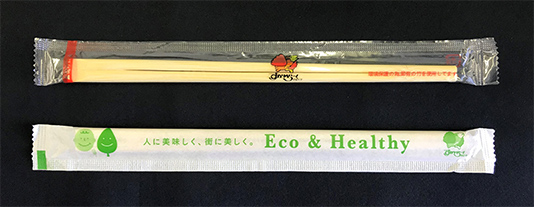
Changed individual packaging of bamboo disposable chopsticks from plastic to paper |
| September 2020 |
Changed some take-out and delivery containers to materials with at least 50% "talc (lime)" |
| January 2022 |
Biomass straws replaced with FSC-certifiedⓇ paper straws |
| February 2022 |
Cutlery changed from biomass plastic to wood |
| December 2022 |
Received the 12th Achievement Award for Promoting Biomass Products (Japan Biomass Products Promotion Council) |
| January 2023 |
Cutlery (forks) for take-out and delivery changed to bamboo |
| January 2023 |
Charged for cutlery, plastic bags, and Mottainai packs |
Reduction Targets for Specified Plastic Products
| Usage of Take-out & Delivery Cutlery and Straws |
| 2020 Actual Usage |
156t |
| 2022 Usage Target |
39t(75% reduction) |
| 2023 Usage Target |
0t(100% reduction)
|
Elimination of Plastic Straws
As an initiative to reduce the amount of plastics we use, as of January 2022, we are gradually replacing our existing biomass straws at each store of Skylark Group to FSC Certified Ⓡ paper straws.
Effects of Straw Switching (Amount Used)
- Reduced by 89% compared to 2018
| 2018 |
Approx. 100 million straws |
| 2019 |
Approx. 31 million straws
Abolished provision of Skylark Biomass Straws® at the drink bar and instead, are providing them only to customers who request them |
| 2020 |
Approx. 11 million straws
With the understanding and cooperation of our customers with regard to conservation of resources, the total amount of straws used is decreasing year by year |
Past Activities
Straw Specifications
- FSC Certified Ⓡ Paper straws are available for customers who order the drink bar by request
Individual Packaging of Bamboo Disposable Chopsticks Changed from Plastic to Paper
As of Saturday August 8, 2020, we changed the packaging of our bamboo disposable chopsticks from plastic to environmentally friendly paper at all Skylark Restaurants locations.
Change from Plastic Shopping Bags to Biomass Plastic
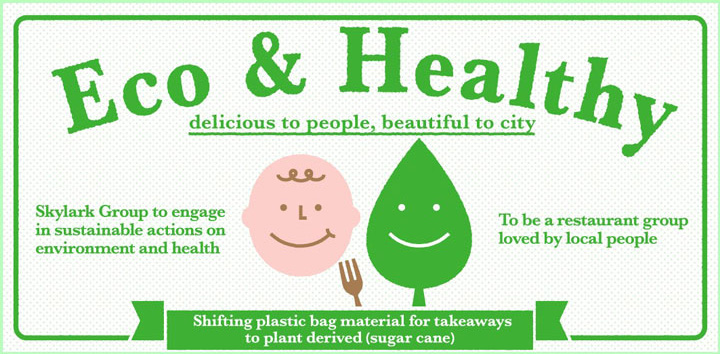
In December 2019, we changed our take-out plastic bags from petroleum-derived plastics to environmentally friendly biomass plastic.
Biomass plastics are synthetic resins made from biological resources (biomass), and the material introduced in Skylark is made from raw materials derived from plants (polylactic acid and corn).
From January 2023, we have started charging for plastic bags for take-out from the viewpoint of conserving limited resources. (5 yen per bag)
Changed Cutlery from Biomass Plastic to Wood
In February 2020, cutlery (spoons, forks, and knives) for take-out and home delivery was changed from petroleum-based plastic to biomass plastic. As an effort to further reduce plastic usage, cutlery (spoons, forks, and knives) for takeout and home delivery at each restaurant of Skylark Group was changed from biomass plastic to wood in January 2022.
Effects of
Switching Cutlery |
- Use of disposable biomass plastic cutlery reduced by 75% in 2022 compared to 2020
- Plastic use reduced by 86 tons
|
| Effects of Charging for Cutlery |
- Reduced by 75% in 2023 compared to 2022
|